A Note from Will Price

After six years as CEO of Flite, I am thrilled to announce that Giles Goodwin is succeeding me as CEO.  Giles will be responsible for defining Flite's vision, leading our talented team, and working with our top partners and customers to realize the promise of content marketing's future.

First, I want to thank Flite's employees, customers, partners, and investors for allowing me the honor of leading this fine organization. I leave a different and better person for having led Flite.

Second, I am grateful to Giles and the passion and energy he brings to the role. As Flite's founder and President of Technology, Giles is the perfect choice to provide Flite not only continuity of culture and purpose, but also the skills and depth required to chart us to future success.  The Valley treasures founder CEOs for a reason, and I know that Flite will find the combination powerful.

Finally, I am pleased to report that I will continue to serve on Flite's Board of Directors and will work closely with Giles, the team, and our top partners over the months to come.

Here's to the future,

Will

Design Studio HTML5: Designing for the Web, on the Web

Design Studio HTML5: Designing for the Web, on the Web

In April, 2010, Steve Jobs’ “Thoughts on Flash” post marked the end of the desktop/Flash era and the beginning of the HTML5/device era. Jobs argued that Flash’s proprietary technology stack failed to meet the needs of a “touch”, open, and “full web” world. Jobs predicted that HTML5 marked the future of the industry and would win the device and desktop world.  Three and half years earlier in 2006, Google launched Docs, a seminal moment in moving desktop applications to the cloud. Seven years later, millions of former Office users rely on Google.  A new generation of consumers will never use a desktop-based word processor or spreadsheet.

Read More

5 Trends That Will Change Advertising in 2013

It’s been a spectacular year for innovation in the digital ad space. As we look toward the future, here are 5 Trends That Will Change Advertising in 2013.

Interactive, informative ad units continue to trump traditional ads as users click less on static messaging. There is also a shift toward higher-quality formats such as native display ads and IAB Rising Stars.

Full-screen mobile ads and interstitial ads are rising relative to small banners which are proving challenging to execute and track properly on devices. Early successes show that ad experiences specific to mobile, such as location-aware couponing and tap-to-call features, will become more prevalent and drive conversions.

Social, useful, real-time ads are replacing the old and tired banner. Display ads are trending toward looking like and doing what the rest of the web already does.

New ad aesthetics are emerging, moving away from driving click-throughs in lieu of showcasing content. Ads now require a user interface that indicates to the consumer that clicks won't necessarily cause them to leave the page.

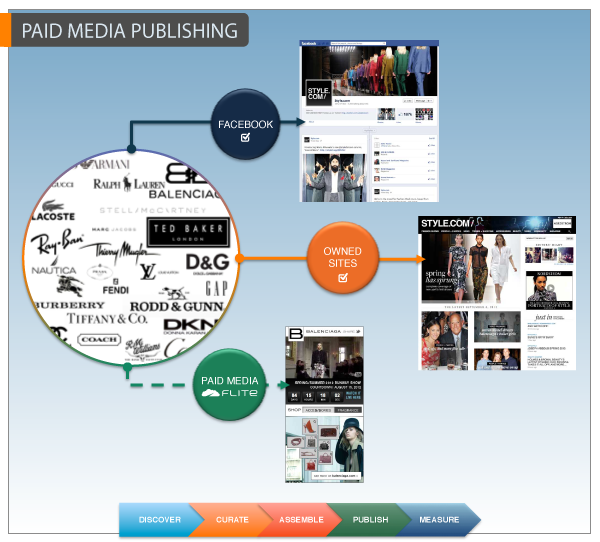
Brands are publishing content to paid media, like they already do to their websites and social media. This is the biggest change happening in brand storytelling right now. As brands become publishers, they are turning to paid media publishing as a crucial method for extending their reach beyond their owned and earned media.

Paid media publishing also redefines the nature of an ad, from essentially just an image and a link, to actual content that is both conversational and influential. I have no doubt that we’re going to see a lot of great-looking, content-rich ads in 2013.


Learn More about Paid Media Publishing:


What is Paid Media Publishing?

Many of the world’s biggest brands have instituted a daily practice of actively publishing fresh content into their owned and earned media, like their branded websites and Facebook, respectively. Brand marketing through this form of content publishing provides brands a way to connect with their audiences through contextually relevant and real-time content.

However, due to limitations in traditional advertising technologies, brands have not been able to apply a similar publishing practice to their paid media (e.g. display ads). With new innovations from companies like Flite, brands can now publish their content marketing through paid media channels for the first time, at scale.

Read More

Don’t Outsource Your Future: Why Publishers Need to Invest in Ad Product Teams

Flite believes ad products are a core competency of today’s leading publishers. Moreover, Flite believes that it is time to move away from full service rich media vendors and to invest in the people, processes, and technologies that turn native ad format programs into a core competency.

Why?

Simply put, audience is now a commodity. Running standard agency creative against a ComScore reach number is a fungible offering and race to commodity pricing. Audience based buying fails to capture the premium nature of the web’s top publishers.

What are the best publishers doing to combat commoditization?

Read More

Flite Featured in AdExchanger

David Kaplan of AdExchanger recently published two excellent interviews with Flite customers, Conde Nast and Forbes.

David's interview with Josh Stinchcomb, Conde's VP for Corporate Partnerships, provides in-depth insight into how and why Conde Nast uses Flite to realize value.  Josh reviews how Flite supports Conde Nast's premium ad product strategy, enables both innovation and scale, and provides comprehensive metrics to help drive insights and optimizations.

Read More

Why Flite is a SaaS Company in a CPM-centric World

Flite is revolutionizing both the technical and business models of the ad tech industry. This post will focus on the power of our business model, software-as-a-service and why it matters.

Since inception, the ad tech industry has operated on a CPM basis. Vendors negotiate MSAs and rate cards, drive revenue via ads served, and work to constantly remind customers to use them in upcoming campaigns. Sound familiar?

Vendors generally perform the work associated with a campaign and the customer therefore buys the output of the vendor's platform rather than the platform itself.

Read More

Weekend Reading: OMMA's Is Google Unstoppable and Opera's State of the Mobile Advertising Business

John Capone's cover story in OMMA Magazine on Google, Is Google Unstoppable, is a good read.

Google's strength in display is well documented and the article highlights the market's three leaders:

  • Facebook ($1.73bn)
  • Google ($1.71bn)
  • Yahoo!

However, Google's growth is red hot and the company's 2013 display revenues are forecast to be $4.7bn. Capone notes that Google's display growth rate is 46% vs Facebook's 27%.

Read More